
Correctional Center Release Paths
Madison Parish Correctional Center belongs to the local-jail network that houses people under more than one authority. A local prisoner may leave under bond, a court order, time served, or sentence completion. A DPS&C prisoner housed in Tallulah remains a state case. That person’s release date, diminution credits, parole status, and final discharge are state matters even though the person slept in a parish-operated building.
A transfer closes the center’s physical custody but does not end detention or a sentence. The receiving facility should create a new custody record, while transfer papers leave with the person. Community release can still include parole or probation. Parole is conditional release during a prison sentence; probation is court-ordered community supervision. Full discharge is a distinct end event. The recorded destination and release authority distinguish them.
Confirm Correctional Center Release
Begin with the exact facility name and custody episode. Similar Tallulah names can cause a request to reach the wrong site. The state public locator uses Louisiana VINELink, but it is not a permanent local release archive. Facility and court records remain essential for a local prisoner. The DPS&C master record is the stronger historical source for a state prisoner.
- Gather the person’s name, booking or DPS&C number, approximate dates, case number, and the “Madison Parish Correctional Center” label.
- Call the center and ask for the physical release or transfer date, recorded destination, and authority.
- Request the release entry, property receipt, transfer sheet, and other event records tied to that custody episode.
- For a local case, compare the event with the Madison Parish Clerk’s criminal minute or order.
- For a state sentence, use VINELink and request DPS&C master-record portions showing movement, sentence computation, release type, and discharge.
A current result can show a state facility or supervision status. No result cannot prove release because updates, aliases, record scope, and retention vary. The Madison Parish released inmates search gives the broader branch for a named person when the starting facility is uncertain.
Correctional Center Records Contact
The DPS&C Madison Parish directory lists the contact below. Its phone is shared with the detention-center listing, while the fax differs. State inspection material also uses the longer label “Madison Parish Correctional Center / Madison Parish Southern Facility.” Include both names when seeking an older record.
Madison Parish Correctional Center
158 Treatment Plant Road
Tallulah, LA 71282
Phone: 318-574-0584
Fax: 318-574-4652
Call to confirm the current entrance, records custodian, and access hours.
Specify the date range and authority in the request. Ask whether the center or DPS&C holds the master record. Local court minutes come from the Madison Parish Clerk. No researched source publishes a facility release-record fee schedule, so verify any cost and accepted form of request before sending funds.
Correctional Center Inspection Facts
The corresponding state inspection reports an operational capacity of 898. On December 7, 2023, it recorded 780 DPS&C prisoners and 49 local prisoners. Those figures describe one dated inspection and must not be presented as the current population. They do establish that the center held a large state population beside local prisoners, making the legal-custodian check central to every release inquiry.
The audit records a signed property return at release. It also says required medication and community-service information were supplied and answers yes to two valid forms of identification. Transfer records accompany a person moved elsewhere. These findings supply useful record targets, but they are date-specific procedures, not a guarantee of what every individual received.
Correctional Center Release Papers
Ask for the release or transfer entry first. Then request the signed property receipt, identification documentation, medication-release record, community-service information acknowledgment, and transfer sheet when applicable. Each item answers a narrow question. The property receipt may support the processing date, while the transfer sheet can identify continued custody. Neither replaces the formal release authority.
The manifest includes a facility-specific image from Louisiana R.S. 15:571.5, addressing supervision after release under the statute’s terms.
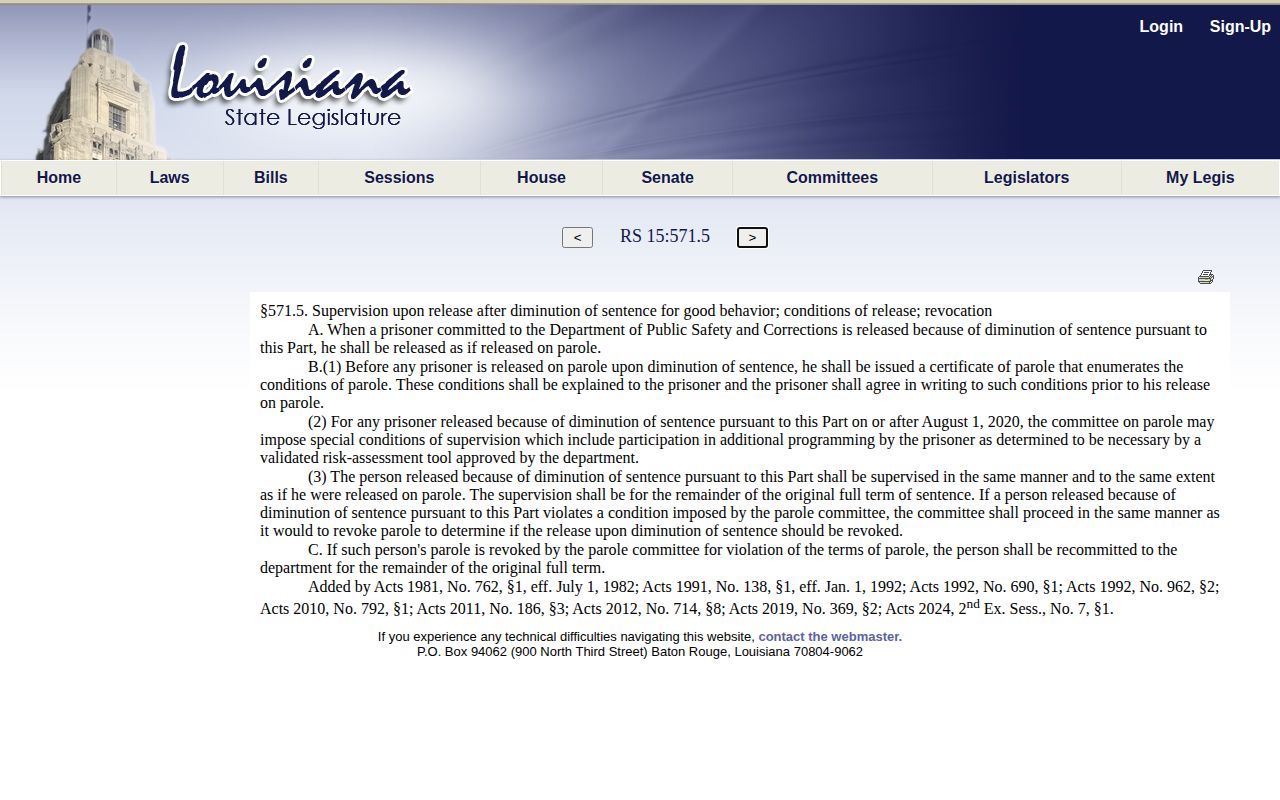
The law is context for a state sentence. The person’s DPS&C time computation and event record remain necessary to establish the actual date and status.
Correctional Center Address Differences
Madison Parish’s official facility records use several close names and evolving address presentations. The correctional center is listed at Treatment Plant Road, while the current detention-center card uses Old Highway 65 South. Bayou sources also vary. Shared numbers and overlapping local/state roles do not erase those names. Retain the exact label from the booking or movement paper.
Call before visiting. An older record may remain indexed under “Southern Facility,” while current staff may use a shorter name. In a written request, list both aliases, the person’s number, and the date. That approach preserves the source discrepancy and reduces the risk that staff search only one index.
- Legal custodian
- The authority that controls the person’s confinement and release.
- Transfer
- A move in which custody continues.
- Diminution
- A sentence reduction earned under applicable Louisiana law.
- Discharge
- The recorded end of the relevant state custody or supervision term.
Who Authorized Center Discharge
The building operator can verify a physical movement. The Madison Parish court can prove a local bond, dismissal, sentence, or time-served order. DPS&C controls a state sentence, including computation and discharge. A supervision office may confirm parole or probation after community release. Each office proves a different part of the event.
Match the next search to the destination. A receiving jail proves a transfer. VINELink and DPS&C records address state custody. BOP or ICE should be used only when the local paper identifies a federal or immigration handoff because Madison Parish has no researched federal prison or ICE detention center. Asking “whose sentence and whose release authority?” keeps physical departure from being mislabeled as final freedom.
Note: The inspection’s mixed local and state count makes authority, not the building name alone, the decisive release-record question.
Audit Trail for Center Releases
The 2024 Madison Parish Correctional Center inspection supplies an unusually specific checklist for a departure. It reports that property is returned against a signed receipt, required medication and community-service information are supplied, and two valid forms of identification are addressed affirmatively. For a transfer, records accompany the person. Each detail supports a separate, focused request rather than a vague demand for every record.
Ask first for the formal release or transfer entry. Then name the signed property receipt, medication-release documentation, community-information acknowledgment, identification documentation, and transfer packet when each applies. These papers can corroborate processing and destination, but they do not all prove the same fact. The formal event record and release authority remain central. A transfer packet points to continued custody, not community release.
The inspection’s 780 DPS&C and 49 local prisoners make the distinction concrete. A state prisoner’s paperwork follows DPS&C sentence authority even when facility staff handled the physical exit. A local prisoner’s court minute may control the legal release. Use the person’s number and classification from the relevant episode to determine which system owns the durable record.
The dated count cannot be projected into the present. It should not be used to claim current population, capacity use, or release volume. Its value is structural: it proves that the facility served a mixed state and local population at that point. That mixed role explains why one roster or one office cannot answer every release question.
When the papers conflict, preserve each timestamp and ask which authority controlled custody at that moment. A facility movement time can precede a receiving admission or state database update. Matching those entries by name, number, and date produces a defensible chain without treating an operational delay as a new release event.
Center Name and Authority Check
Angle L is the local name and address problem. The parish directory lists 158 Treatment Plant Road, while the detention center has a different current highway card, and both listings use 318-574-0584. Keep the correctional center’s distinct fax and the “Southern Facility” inspection alias. Call before visiting and give the record date.
Angle T is the authority problem. Ask whose sentence and whose release authority governed the departure. Facility staff prove movement, the clerk proves a local judicial act, DPS&C proves a state discharge, and a receiving facility proves transfer. Preserving those roles prevents a shared phone number or campus relationship from flattening legally different events.