
Madison Parish Projected Versus Actual Release
A projected date is the responsible corrections agency's calculation as of a stated point in time. It starts with the court's sentence, commencement date, and credit for time already served. The custodian then applies the rules that govern that person, including eligibility for diminution of sentence, earned credits, lost or restored credits, consecutive or concurrent terms, and later legal events. Diminution means a lawful reduction in time to be served. It is often called good time.
An actual release date records a past event. It may show discharge to the community, release to parole, or departure to another legal authority. Destination matters. A detainer can cause a person to leave DPS&C custody and enter another agency's custody on the same day. Therefore, an actual date is stronger evidence than a projection, but it still must be read with the release type and destination.
Scheduled versus actual: a projected date can move. Only the final Madison Parish facility or DPS&C event record proves that release occurred.
A pretrial detainee usually has no computed release date. Bond, recognizance, dismissal, a court order, or case disposition controls departure. A parish sentence may have a local calculation. A state sentence remains a DPS&C matter even when the prisoner is housed in a Madison Parish facility.
Find a Madison Parish Projected Release
Begin with legal custody, not the building name. Madison Parish Detention Center, Madison Parish Correctional Center, Bayou Correctional Center, and the Louisiana Transitional Center for Women can involve people tied to state corrections. A local address does not make every sentence a parish calculation. Ask whose sentence is being served and which agency has release authority.
- Identify the person with the full name, date of birth when appropriate, court case number, booking number, and DPS&C number if assigned.
- Read the sentencing order. Record the offense date, sentence length, commencement date, jail credit, and whether multiple terms run together or one after another.
- For a Louisiana state sentence, open the official DPS&C inmate information page, then follow its Louisiana VINELink route. Read the exact date label rather than assuming it is a release promise.
- If the web record lacks a date, call the DPS&C locator at 225-383-4580 with the DPS&C number or the name and date of birth. Ask for the “projected release date, if applicable.”
- Send calculation questions to DPS&C time computation at 225-342-0799. For a local parish sentence, ask the facility custodian and court how jail credit and lawful diminution were applied.
- After departure, obtain the actual release or discharge entry and compare its type, time, authority, and destination with the earlier estimate.
The Madison Parish release records path covers the sheriff, court, DPS&C, and federal branches when custody is uncertain. A missing online date is not proof of imminent release. DPS&C says calculation can remain incomplete while newly sentenced cases await official sentencing paperwork.
Note: Ask for the calculation's “as of” date because sentence credits, orders, and custody events can change after the answer.
Madison Parish Release Date Fields
Similar labels answer different questions. Keep each one in its own column when recording search results. Do not replace a missing projected date with parole eligibility or the sentence printed on a docket.
| Field | What it establishes | Limit |
|---|---|---|
| Sentence length | Term imposed by the court | Does not by itself apply jail credit or lawful diminution |
| Projected or tentative release date | Agency's current time-computation estimate | Can change before release |
| Parole eligibility date | Earliest possible point for consideration under applicable law | Not a hearing grant or release date |
| Parole decision | Committee action on a case | Must be followed by the actual release event |
| Actual release or discharge date | Past event recorded by the custodian | Does not alone show destination or ongoing supervision |
Louisiana's public interface is dynamic. It may use “Estimated Release Date,” “Projected Release Date,” or a related phrase for an eligible current record, and not every provider displays the same fields. The telephone locator expressly uses “projected release date (if applicable).” Record the label exactly as presented, the source, and the date checked.
Louisiana Credits Affect Madison Release
Louisiana's good-time framework depends on offense date and eligibility. R.S. 15:571.3 governs older cohorts through schedules and exclusions that have changed over time. A newer provision, R.S. 15:571.3.1, applies to offenses committed on or after August 1, 2024. For an eligible felony prisoner in parish prison or DPS&C custody, subsection B permits diminution up to 15 percent of the sentence.
That maximum produces an 85-percent floor only for a person who falls within the newer provision and qualifies. It is not a universal Louisiana calculator. The subsection excludes sex offenses under R.S. 15:541 and habitual-offender sentences under R.S. 15:529.1. Presentence credit does not itself earn this good time. Credits may be forfeited, and the DPS&C secretary is the credit authority. Older offenses require the law and schedule that applied to their cohort.
The manifest image below comes from the official R.S. 15:571.3.1 text.
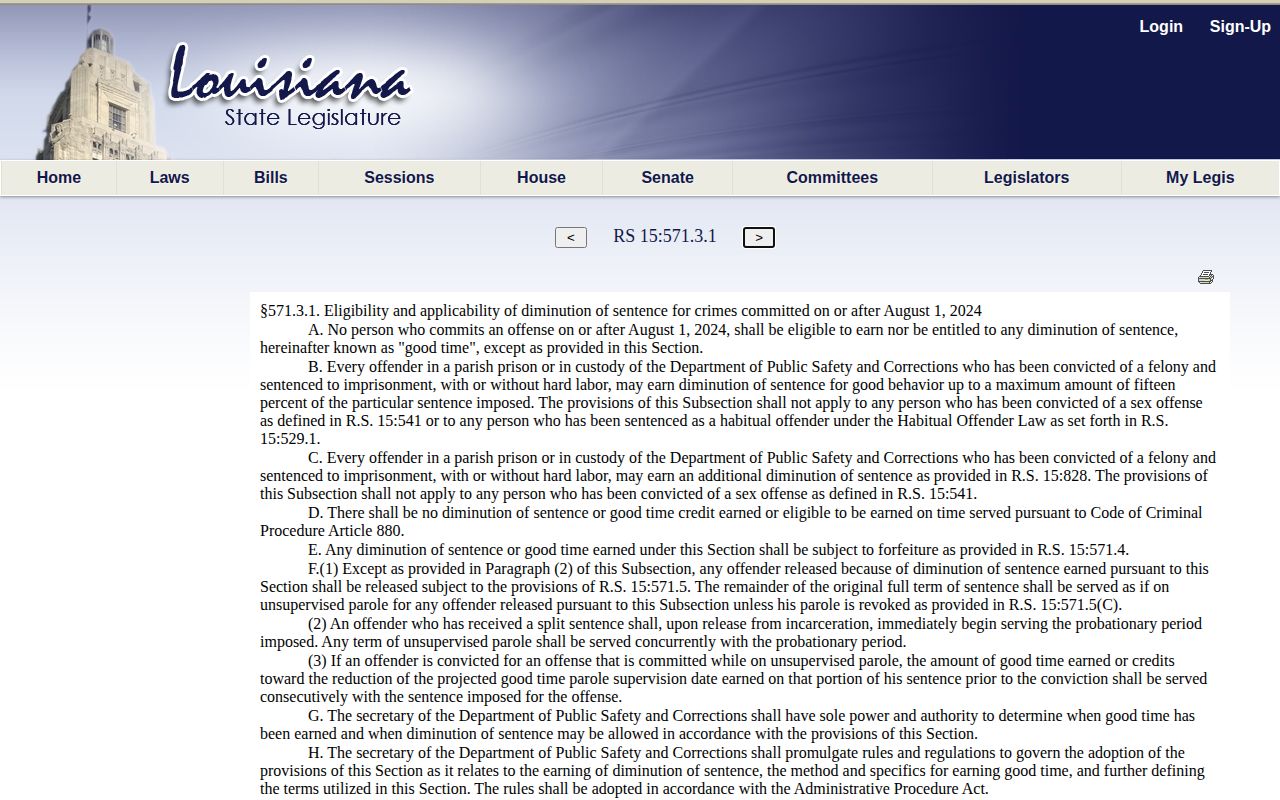
The statute supports a cohort-specific credit analysis. It does not justify subtracting 15 percent from every Madison Parish sentence.
Note: Never carry the newer 85-percent shorthand back to an older offense without checking the controlling law and exclusions.
Why Madison Release Dates Change
A projection changes when the inputs change or when the agency corrects the calculation. Some events move the estimate earlier. Others move it later or change only the destination. The actual effect is person-specific and must come from the current computation.
| Factor | Possible effect | Record to check |
|---|---|---|
| Corrected jail credit | Moves the estimate after time already served is recalculated | Court order and DPS&C computation |
| Amended or vacated count | Changes the controlling sentence structure | Signed court order |
| Consecutive sentence added | Can extend the aggregate term | Sentencing record and computation sheet |
| Credit earned, lost, or restored | May shorten or lengthen the projected term | DPS&C credit record |
| Parole action or revocation | Can alter the route to community supervision or return to custody | Committee decision and supervision record |
| Detainer or hold | May change where the person goes when one custody ends | Release destination and receiving-agency record |
| Law change | Applies only under its effective-date and coverage rules | Current statute and agency computation |
Parole deserves special care. R.S. 15:574.4 contains eligibility routes and exclusions. R.S. 15:574.22 makes most people committed for offenses on or after August 1, 2024 ineligible for parole except for stated categories. Eligibility, a hearing date, and a grant are three different facts. The facility release entry supplies the later event.
Madison Transitional Work Is Custody
Madison Parish's transitional-work placements make physical visibility a poor test of release. A participant may perform approved work or other activity outside a secure building while still serving a sentence. Movement out of a program can mean transfer, return to secure custody, parole release, or full discharge. None should be inferred solely from where someone was seen.
The DPS&C facility directory identifies the Tallulah transitional-work network and its correctional context. Use the exact facility movement record, the current DPS&C time calculation, and the final event record. If release is to supervision, add the assigned probation and parole district. This sequence answers both when correctional custody ended and what legal status followed.
This Madison-specific issue also affects records requests. Cite both the facility's official name and any documented alias, the approximate movement date, and the DPS&C number. Similar Tallulah facility names should not be merged into one assumed campus or one release authority.
Check Current Madison Release Law
Sentence rules must be read as of the relevant offense and calculation dates. The Louisiana Legislature's law search is the safest starting point for current text and linked history. It helps separate an older schedule from the newer credit provision, but the agency still performs the person-specific calculation.
The captured Louisiana Legislature law search is the official route for checking the current statutes.
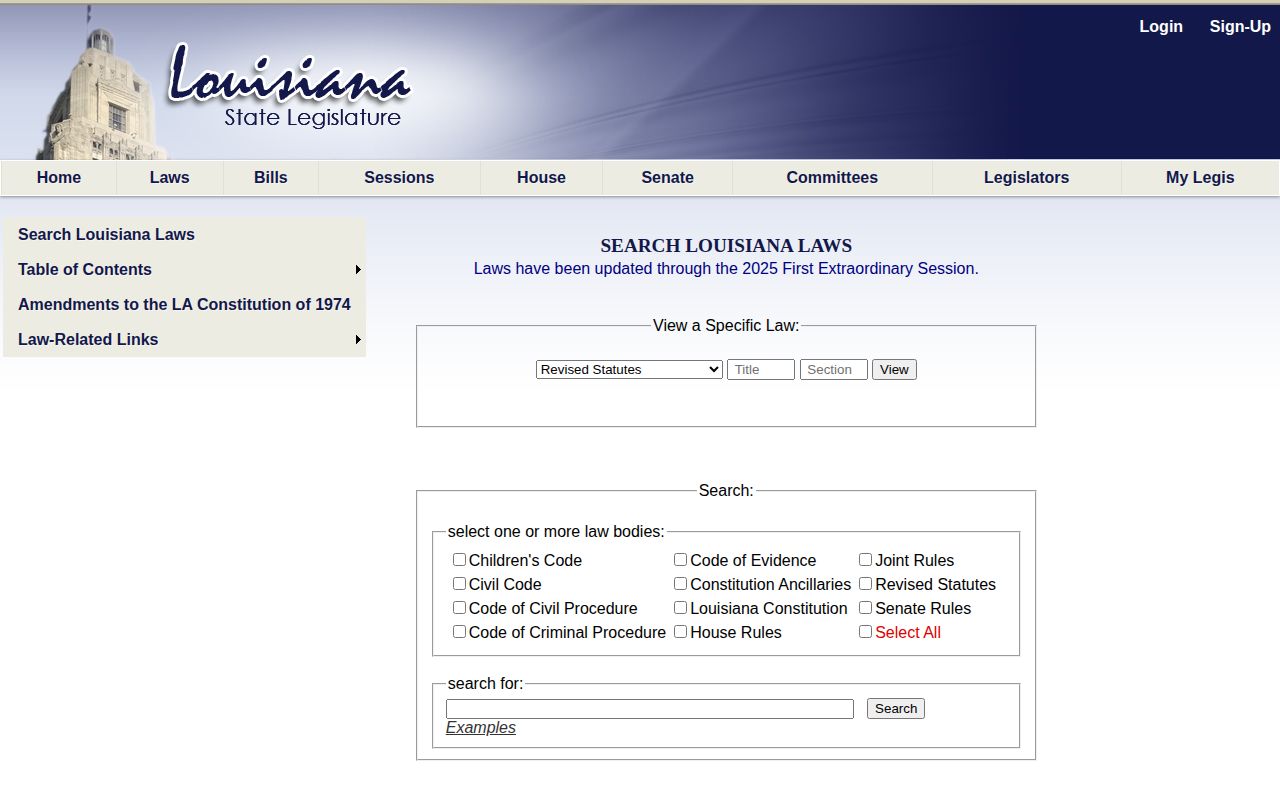
Use the search to confirm R.S. 15:571.3, 15:571.3.1, 15:574.4, and 15:574.22 before relying on a date explanation. Then ask DPS&C which provision it applied.
Confirm Madison Parish Actual Release
A pending date can be monitored, but notification is not the final record. Louisiana LAVNS through VINELink accepts registration on a matching participating record for offered custody events. The Madison Parish VINELink inmate search explains the name or ID match, notification choices, and confirmation step. Data can lag, so contact the legal custodian after an alert.
For a state prisoner, request the DPS&C discharge date and relevant disposition information. Louisiana R.S. 15:574.12(G)(1)(a) makes general information, including discharge date, available on request even though much of the master prison and parole file is protected. For a parish sentence, request the booking-and-release record from the sheriff or facility and compare it with the court's sentence and credit order.
- Concurrent
- Sentences run at the same time, subject to the court's terms.
- Consecutive
- One sentence follows another and may extend the aggregate term.
- Diminution
- A lawful reduction in time to be served, often called good time.
- Detainer
- A hold or request that may send a person to another authority after one custody ends.
- Discharge
- The agency's recorded completion or end of the custody or supervision status at issue.
Keep the projected result, its exact label, and its “as of” date. Then save the final release entry. If they differ, the later record should explain the change or identify the custodian who can. A complete answer states the actual date, release type, authority, destination, and whether supervision continues.
Build a short calculation file from source records rather than a guessed calendar count. Keep the signed sentencing order, the custodian's jail-credit figure, each published projected date, and any later court amendment. Add the parole decision only when one exists. If a facility reports a different date from DPS&C, ask whether the difference comes from delayed paperwork, a corrected offense date, sentence aggregation, or credit action. Do not choose the earlier answer merely because it is more favorable.
For someone held before trial, monitor the court instead of trying to create a sentence projection. A bond action, recognizance order, dismissal, plea, or sentencing event can change the path. The jail may record a release only after it receives and processes the controlling order. For a sentenced person, the reverse is true: the court supplies the legal sentence, while the lawful custodian applies the time calculation and records the actual departure.
A request for the final Madison Parish release record should name the specific booking or sentence episode. Ask for the release date and time, code or type, releasing authority, destination or transfer agency when releasable, and the time-calculation document. This separates a true community release from a transfer between Tallulah facilities or a handoff to another authority.